
Reasons why your hearing aids are whistling

Understanding why hearing aids whistle
Why do hearing aids whistle?
If you notice a whistling sound in your hearing aids, you’re definitely not alone. It’s known as hearing aid feedback, and it’s a high-pitched noise that can occur when sound that should go into your ear canal is detected by the microphone of your hearing aids and gets amplified.1
This is different from tinnitus, where you hear a high-pitched noise coming from inside your ear. Hearing aid feedback is common and often easy to fix. Here are seven possible reasons for whistling and what you can do about it.
How to stop hearing aid feedback
Reason 1: Improper fit
Solution: Fitted earmoulds
Get new earmoulds fitted to your ears so that they sit snugly. If you’re unsure, visit your hearing care professional for guidance and support.
Reason 2: Earwax or debris buildup

Solution: Examination and Cleaning
Have your ears examined and cleaned by a health professional, and also check your hearing aids to make sure the receivers and vents (tiny openings in the hearing aid tubes) are not clogged.1
Reason 3: Damage to hearing aid tubing
Solution: Replace tube
Visit your local Bloom Hearing Specialists store to arrange a replacement tube.1
Reason 4: Volume set too high

Solution: Adjust volume
Turn down the volume of your hearing aids and avoid the point where the sound becomes so loud that it creates feedback. Modern hearing aids feature advanced technology that reduces feedback.
If you find that you would like the volume of your hearing aids turned up, follow up with your audiologist to fine-tune your hearing aid settings for best results.

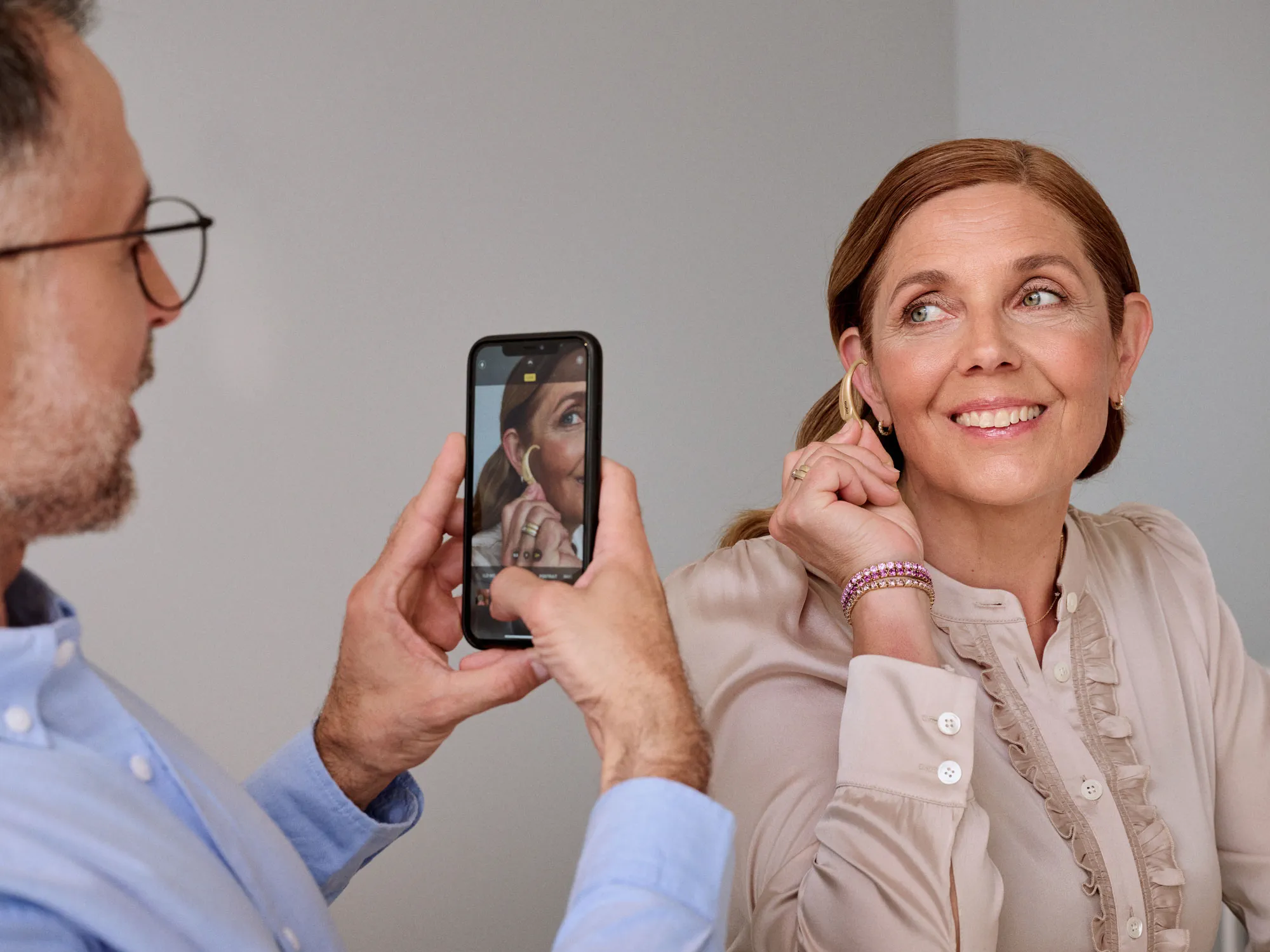
Reason 5: Incorrect insertion
If you’re new to wearing hearing aids, or you’ve switched to a new style, rest assured that a period of adjustment is completely normal. Still, it’s important to check that your device is properly inserted.
"If your hearing aids aren't fitting just right, sound can get out and be picked up again through the microphones, which leads to a whistling sound," explains Durrheim.
Solution

Correct sides
Identify the left (blue) and right (red) devices
Handling
Hold your hearing aids between your thumb and forefinger
Inserting
Gently insert it into your ear canal, following the natural shape, until snug with the wire sitting flush against the outer ear
Reason 6: Your hearing has changed
Solution: Visit us
"You may need a different dome or even a custom earmould for a better seal and to help prevent feedback," Durrheim says. "Switching to a better fitting option often solves the problem."
If home cleaning and maintenance aren’t helping you enjoy clear and comfortable sound, get in touch with an expert audiologist for personalised advice.
Reason 7: Technical malfunction

Solution: Contact your hearing care professional
Nobody likes a technical malfunction, especially not with hearing aids. Reach out to your hearing care professional so they can help you investigate and ensure your hearing aids are correctly adjusted or repaired.

1. Widex: 5 Reasons why your hearing aids are whistling:
https://www.widex.com/en-ca/blog/global/5-reasons-why-your-hearing-aids-are-whistling/
2. Surmeli M, Deveci I, Canakci H, Canpolat MS, Karabulut B, Yilmaz AAS. Effect of Body Mass Index on Auricular Morphology and Auditory Functions. Ear, Nose & Throat Journal. 2019;98(7):E81-E86. doi:10.1177/0145561319840579